 FDM Printers



3D Printing in Lebanon: PLA vs PETG — Which Material Should You Choose?
Choose a material around the job your part must do, not only its colour or the lowest quotation.
Quick checklist before sending
- State how the part will be used
- Identify heat, handling and appearance needs
- Include the final dimensions and quantity
Possible, but fragile
Do not design below 1 mm. At about 1 mm, a feature may still break, deform, or fail depending on its length, shape, orientation and support.
Stronger and safer
Use 2 mm or more where the design allows. Long, unsupported or heavily handled parts may need to be thicker.
Relative comparison: the 1 mm line is shown at half the thickness of the 2 mm line. Your phone or monitor is not a physical ruler. Measure the feature in the model at final production size.
Start with the purpose of the part
Before choosing a material, tell SHARK whether you need a presentation model, a decorative object, a fit-check prototype or a part that will be handled repeatedly. Explain where it will be used and which surfaces need to look their best. A model for a university presentation and a bracket used every day do not have the same priorities.
Where PLA and PETG differ
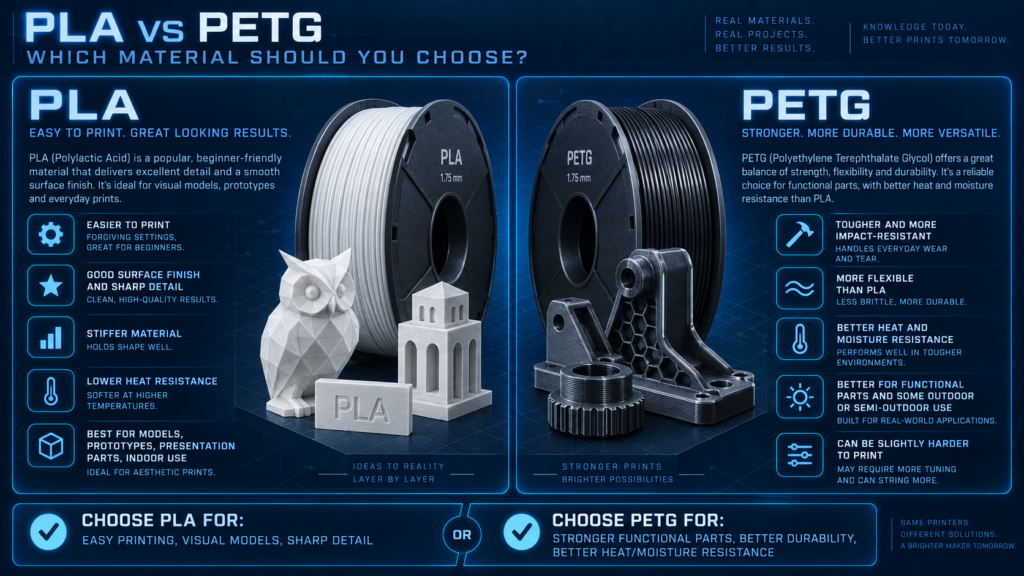
PLA is a common choice for detailed display models and concept prototypes that do not need high temperature or impact resistance. PETG is generally tougher and more temperature-resistant, but its finish, bridging and support removal can need different preparation. Neither name alone guarantees a particular strength: geometry, orientation and the actual filament grade matter.
| Project priority | Starting discussion with SHARK |
|---|---|
| Indoor display model or visual prototype | Consider PLA; identify fine visible surfaces. |
| Repeated handling or practical prototype | Discuss PETG, wall design and expected loads. |
| Heat, direct sunlight or outdoor exposure | Describe the environment before selecting either material. |
| Parts that fit together | Agree on clearance and test a small joint first. |
What changes the quotation?
Provide the final dimensions and quantity rather than requesting a price from a screenshot. The quotation considers the model, material, printing setup, supports and any finishing or assembly requested. A small but awkward part can take more preparation than a larger, simple shape. A reduced scale can also make a previously suitable feature too thin.
Choose appearance deliberately
Send a reference for the appearance you need: a natural printed finish, a painted model or a presentation piece assembled with other materials. Mark the important face on a screenshot. Do not assume that changing from PLA to PETG eliminates visible layer lines, or that a filament colour will exactly match a screen.
At final production size, do not design small separate pieces or fragile structural features below 1 mm. Features around 1 mm can be very fragile and may break, deform, or fail during printing, assembly or handling. Where the design allows, use 2 mm or more for stronger, safer features. Long or unsupported elements may need to be thicker.
What to send SHARK
Send the STL, the intended width × depth × height in millimetres, quantity, intended use, preferred colour and required finish. Add a screenshot showing the most important face. When fit is important, identify the matching part and the dimension that must be checked.
Can I use the same STL for both materials?
You can request a comparison using the same geometry, but SHARK must review whether that geometry suits each material and the intended use. Do not treat a visual prototype as a validated functional component without an appropriate test.
Continue with STL file preparation or explore 3D printing and prototyping at SHARK.
Technical references
Software interface wording may vary by version. Production settings must match the actual job.